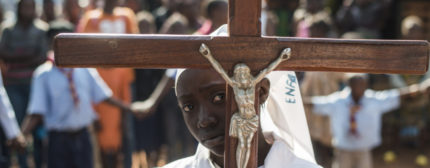
Last Easter, over two billion Christians around the world celebrated “the Resurrection of Christ,” and a large percentage of them were black.
According to a 2007 Pew Report, 78 percent of Blacks in America identify as Protestant while a 2011 report by Pew notes that nearly 24 percent of Christians live in Sub-Saharan Africa.
Christianity’s explosion across Africa led many to call for the Vatican to select a successor to Pope Benedict from the Continent with Ghanaian Cardinal Peter Turkson among the suggested shortlist. This said, many think of Christianity as “the White man’s religion.”
The Christian faith occupies a complicated, often racialized place in the history of blacks all over the globe because of how it was abused by white colonists and slave traders to subjugate Africans.
“Christianity was a double-edged sword [for African-Americans],” says Dr. Lawrence H. Mamiya, Professor of Religion and Africana Studies at Vassar College and co-author of The Black Church in the African American Experience.
“On the one hand, well, whites wanted to use Christianity to make slaves docile and obedient. [On the other hand,] the Africans adapted Christianity for their survival and liberation.”
But long before colonialism and slavery, Africans were practicing Christianity. “We know that Christianity has had a long history in Africa itself, pre-dating any kind of European influence,” Mamiya says.
Christianity reportedly arrived in North Africa in the latter part of 1st century AD, early part of the 2nd, while “the adoption of Christianity in Ethiopia dates to the 14th century,” according to findings by the Metropolitan Museum of Art.
The Bible also documents the conversion of an Ethiopian eunuch as the early church was forming. Likewise, Moroccan explorer Ibn Battuta mentions Christians in Nubia (an area that covers present-day northern Sudan and southern Egypt) in his 14th century travelogue. But when Europeans penetrated Sub-Saharan Africa in the 16th Century, ultimately mining the region for Africans to enslave, the historical narrative shifts, which is perhaps why many associate the religion most with Europeans to this day.
Dr. Leslie King-Hammond, historian, artist, curator and Dean of the Maryland Institute College of Art, observes, “many of the Africans who came to the New World, probably had already had contact with Christianity from missionaries who were stationed on the Continent.” Once in America, many Africans faced a confusing range of options with respect to the religion. While some slaveholders encouraged conversion to Christianity, others did not…
Read More: freerepublic.com