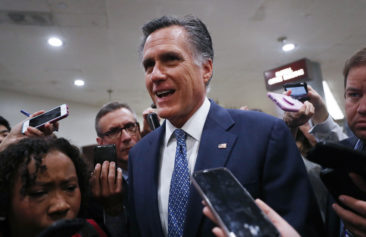
During his visit to Israel, GOP presidential candidate Mitt Romney gave a much-criticized speech to Israelis in which he claimed that “culture makes all the difference” in explaining why some countries thrive, like Israel, and some countries don’t, like Palestine.
Romney referenced a Pulitzer Prize-winning book by scientist Jared Diamond called Guns, Germs and Steel and basically said that while Diamond writes it was the early presence of minerals like iron, which could be used to build weapons, Romney didn’t think that was completely accurate. Romney believes culture should be taken more into account. He has made this argument many times over the last several years—even in his own book, last year’s No Apology: Believe in America.
But in an op-ed piece in the New York Times on Wednesday headlined “Romney Hasn’t Done His Homework,” Diamond says Romney “misrepresented” his views.
“That is so different from what my book actually says that I have to doubt whether Mr. Romney read it,” writes Diamond, currently a professor of geography at UCLA. “My focus was mostly on biological features, like plant and animal species, and among physical characteristics, the ones I mentioned were continents’ sizes and shapes and relative isolation. I said nothing about iron ore, which is so widespread that its distribution has had little effect on the different successes of different peoples. (As I learned this week, Mr. Romney also mischaracterized my book in his memoir, “No Apology: Believe in America.”)
“That’s not the worst part. Even scholars who emphasize social rather than geographic explanations — like the Harvard economist David S. Landes, whose book ‘The Wealth and Poverty of Nations’ was mentioned favorably by Mr. Romney — would find Mr. Romney’s statement that ‘culture makes all the difference’ dangerously out of date. In fact, Mr. Landes analyzed multiple factors (including climate) in explaining why the industrial revolution first occurred in Europe and not elsewhere.”
This is not a place any presidential candidate wants to be, arguing with academics about the interpretations of their life’s work. It’s bound to be a loser for the candiadate. Diamond goes on in his piece to point out that while culture is important in determining a society’s wealth, it certainly doesn’t make all the difference. Diamond pointed out other things that make a difference—geography (countries thrive when the temperature isn’t too hot), access to the sea, agriculture, having institutions that reward hard work.
“What does this mean for Americans? Can we assume that the United States, blessed with temperate location and seacoasts and navigable rivers, will remain rich forever, while tropical or landlocked countries are doomed to eternal poverty?” Diamond writes. “Of course not…Geographic advantages don’t guarantee permanent success, as the growing difficulties in Europe and America show. We Americans fail to provide superior education and economic incentives to much of our population. India, China and other countries that have not been world leaders are investing heavily in education, technology and infrastructure. They’re offering economic opportunities to more and more of their citizens. That’s part of the reason jobs are moving overseas. Our geography won’t keep us rich and powerful if we can’t get a good education, can’t afford health care and can’t count on our hard work’s being rewarded by good jobs and rising incomes.
“Mitt Romney may become our next president. Will he continue to espouse one-factor explanations for multicausal problems, and fail to understand history and the modern world? If so, he will preside over a declining nation squandering its advantages of location and history.”