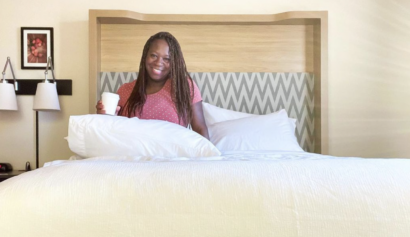
Because of my daughter’s small size, my sister nicknamed her Bean. When she pulls the laundry—that took an hour to fold—out of the basket, I call her a Bad Bean. When she hits her cousin’s in the face, I tell her not to be a Mean Bean. And when she eats all of her vegetables, she’s a Green Bean. One name I never want to use is Baked Bean. Now that the temperature is rising, I must ensure she’s protected from the sun’s harmful rays.
When I lived in the Cayman Islands, sunscreen became a part of my morning ritual. People slathered on SPF as soon as their babies came out of the womb. Maybe Bob Marley had something to do with that. The musical icon died at the age of 36 from a melanoma that started under his toenail. I took his memory with me and returned to the United States, where I saw many African Americans skipping sunscreen. I caught up with the leading pediatric dermatologist Patricia Treadwell to find out why brown babies need sunscreen too.
Heather: Although ethnic groups are less likely to get skin cancer, they’re more likely to die from it. Many African Americans don’t diagnose the disease until the advanced stages. Why is that so?
Dr. Treadwell: African Americans tend to think that they don’t get skin cancer, so they don’t do the same surveillance of moles as their White counterparts. You must be aware of what melanoma looks like and learn the ABCDE warning signs.
Heather: According to the Skin Cancer Foundation, melanin in African American skin provides a sun protection factor (SPF) of about 13.4, compared to 3.4 in Caucasian skin. Is that enough?
Dr. Treadwell: The SPF should be at least 15. I recommend choosing a “physical” or “chemical-free” sunscreen made with zinc oxide or titanium dioxide. These ingredients sit on top of the skin, forming a barrier and protecting as soon as you put them on.
Heather: Some sunscreens cause breakouts. Are there other options?
Dr. Treadwell: Some lotions clog pores and create more oil on an already oily prone skin. In this case, you should select a facial sunscreen, which is much lighter. Also, if you have light or dark spots on your face, sunscreen helps even out your skin tone.
Heather: What sunscreen regimens are other minority moms using?
Monique Johnson of Brooklyn, New York: I follow the EWGs annual rating system. Problem is—most of the best sunscreens make brown folks look purple or white. I’ve tried tons and fell in love with All Terrain Aquasport. Skin color stays the same, and it even offers a nice level of moisture. So far, my daughter’s sunburn-free.
Vee Elliot of Atlanta, Georgia: I use sunscreen on my precious cargo wherever we go, even if it’s the backyard. We must teach our little ones to protect their skin like we remind them to brush their teeth.
Maisia Jackson of Middletown, Delaware: I always check the labels for parabens. I wouldn’t want to apply a cancer-causing agent to my children’s skin when I am trying to prevent them from getting it!
By 2050, the U.S. Census Bureau projects that half of our country’s population will be made up of Hispanics, Asians and African Americans. Now, more than ever, it is crucial to raise awareness about skin cancer in people of color.
Source: Heather Hopson, Black and Married with Kids