University of Florida law student Preston Damsky holds an ideology most would dismiss as beyond the fringe.
In a term paper for a fall semester class on “originalism” — the legal theory interpreting the Constitution’s original meaning favored by most conservative jurists — the 29-year-old California native and self-proclaimed white nationalist didn’t hold back on his racist, transgressive beliefs.
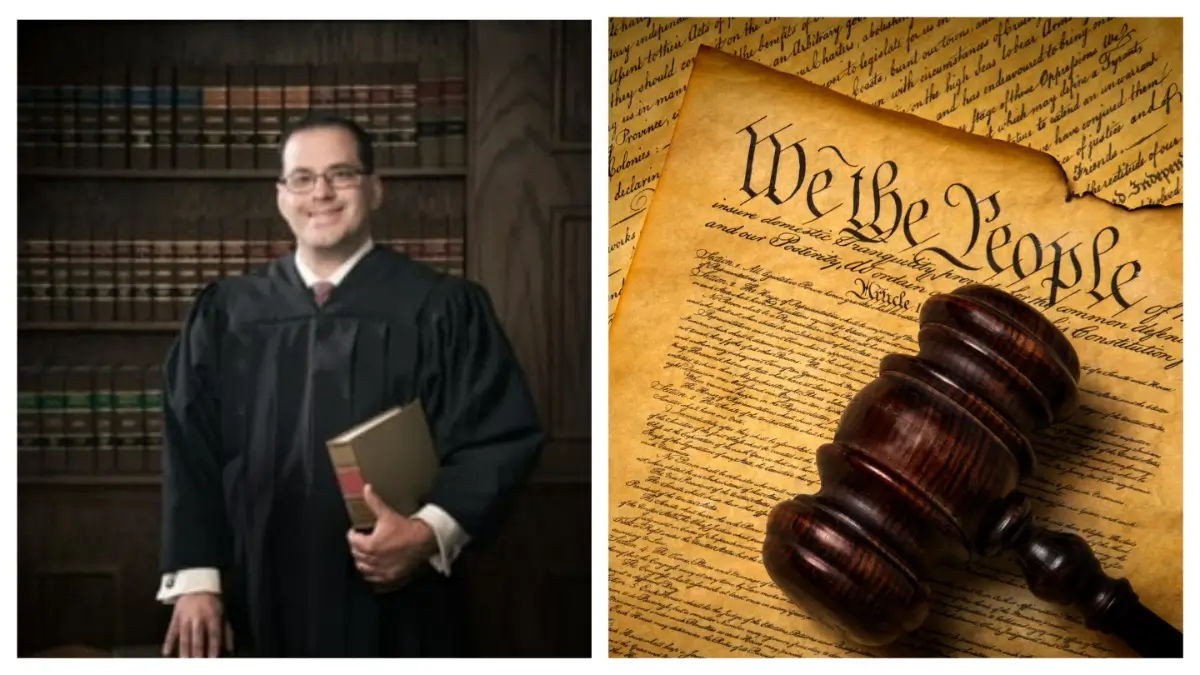
The phrase, “We the People,” refers only to whites, Damsky argued. Non-white citizens, therefore, are not entitled to voting rights protections. He advocated that border agents be ordered to “shoot-to-kill … criminal infiltrators at the border,” The New York Times reported.
White people, he wrote, will be committing a “terrible crime” if they allow a nonwhite majority, which the U.S. Census Bureau predicts will occur around 2045,” to commit this demographic assault on their sovereignty.”
For this, he received the “book award” designating him as the best student in the class. Trump-appointed U.S. District Court for the Middle District of Florida Judge John L. Badalamenti, who taught the class, has not explained why he chose Damsky for the coveted prize.
It was a controversial decision. Students and faculty alike wondered how someone professing those beliefs could receive such an honor. The interim dean of the University of Florida Law School, Merritt McAlister, cited Damsky’s free speech rights, adding professors should not engage in “viewpoint discrimination.”
Then, in March, Damsky inflamed the turmoil by posting on his X account that Jews must be “abolished by any means necessary.” He was suspended by the university, which, according to Hillel International, has the largest number of Jewish undergraduate students in the country. Emails obtained by university officials revealed numerous students feared for their safety.
Damsky was banned from campus and faces possible expulsion but is challenging the punishment. He claims he was unfairly targeted because of his ideas, telling the Times, “I’m not, like, a psychopathic ax murderer.”
But in the same interview, Damsky said calling him a Nazi “would not be manifestly wrong”
His ideology was shaped by white nationalist authors like Sam Francis and Richard Lynn, he told The Times, and he began thinking about becoming a prosecutor after observing district attorneys in cities including Los Angeles and San Francisco adopt policies that he believed were soft on crime.
Even before he won the “book award,” Damsky and his views were well-known around campus. Carliss Chatman, an associate law professor at Southern Methodist University and visiting scholar at the University of Florida, said several Black and Jewish students had expressed their concerns to her.
Chatman noted the changing political climate in Florida has played a major role in the debate over what viewpoints are acceptable. She had proposed teaching a class called “Race, Entrepreneurship and Inequality” but administrators insisted she change the name to “Entrepreneurship” before listing it in the course catalogue.
The Trump administration’s assault on diversity, equity and inclusion initiatives and “wokeness” has established an alarming dichotomy.
“I just find it fascinating that this student can write an article, a series of articles that are essentially manifestoes, and that’s free speech,” said Chatman, “but my class can’t be called ‘Race, Entrepreneurship and Inequality.’”
Awarding a prestigious academic award to Damsky “emboldened” him to begin posting a series of antisemitic screeds on social media earlier this year, she said.
The Times article has ignited a debate on social media over academic freedom and free speech.
“I’ve given lots of excellent grades to papers where I didn’t agree with the findings but their research and arguments were logically sound,” one professor posted on X. “That’s how it’s supposed to work you don’t grade on your opinion of the conclusion but did they argue it well.”
“So, let me see if I understand this,” countered one commenter. “If someone makes a paper about raping 13 years old girls, and it is well argumented, you would grade it outstanding even if you don’t agree with the ideas proposed in the document?”
Chatman said Damsky’s paper was “anti-intellectual” and doesn’t measure up, by any academic standard.
“We fought a whole Civil War that freed slaves and said ‘We The People’ now means everyone,” she said.
The uproar has also put the federal judge who lauded Damsky’s work under the microscope. Badalamenti, who sits on the U.S. District Court for the Middle District of Florida, has won praise from both liberals and conservatives, according to The Times. He considers Justice Ketanji Brown Jackson, who is Black, a mentor who helped him through “difficult times and continues to be a tremendous friend and source of positivity,” Badalamenti told Reason.
For what it’s worth, Damsky said Badalamenti “is not a white nationalist.”
“Don’t get me wrong,” he added. “I would prefer it if he was.”
Damsky has suffered some consequences for his toxic opinions. Before he was suspended, he was offered a summer internship in the prosecutor’s office for the Eighth Judicial Circuit of Florida. But that officer has since been rescinded by Brian Kramer, the state attorney for the Eighth Judicial Circuit of Florida.
Employing someone like Damsky who “espouses those kinds of beliefs would cause significant mistrust in the fairness of prosecutions,” Kramer said.
But critics of Damsky and Badalamenti have also paid a price.
A former classmate told The Times his job offer from a large law firm was withdrawn after he told them he had spoken to the paper and was critical of Damsky and their professor.