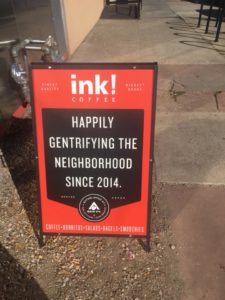
Ink! Coffee pegs itself as a a cafe serving “socially conscious coffee.” (Image courtesy of Twitter/@theperfectRu)
What was intended to be a joke has residents of a rapidly changing Denver community up in arms — and rightfully so.
A sidewalk board displayed outside the Ink! Coffee shop in Five Points before Thanksgiving, that read, “Happily gentrifying the community since 2014,” was no laughing matter to past and present residents of a neighborhood once filled with Black and Latino families, The New York Times reported.
A picture of the board made its rounds on social media last week, drawing the ire of critics who argued that displacement and rapid gentrification are nothing to joke about. Reactions to the flippant message reached a head over the weekend, as angry locals shattered a shop window, scribbled graffiti on the store front, and organized an all out protest march outside the local coffee business.
“My first reaction was, ‘Is this real?’ because it’s just so mind blowing,” writer and event organizer Ru Johnson, who posted the photo to Twitter, told The Denver Post. “Their sign was almost like a poke in the eye for the people who have worked to make the community what it is, and a lot of those people have been pushed out. Who created this sign, sent it to manufacture and put in outside your business?”
Like others who’ve been pushed out, local woman Alizah Wright, 38, said she was forced to move from the neighborhood because she could no longer afford to live there. Costly new redevelopments have sprung up in the area, attracting more affluent locals and fueling the displacement of longtime residents. A portion of Five Points has since been re–named River North, or “RiNo,” according to The Times, while the community’s industrial side is dotted with new shops condos and construction cranes.
Several majority-minority, working class communities across the nation are grappling with gentrification, including Brooklyn, San Francisco, Portland and Atlanta. A 2015 report from Governing magazine found that gentrification in the country’s 50 largest cities has greatly increased in recent years, with nearly 20 percent of low-income communities experiencing gentrification. This is compared to just 9 percent of poorer neighborhoods in the 1990’s.
Amid the backlash, coffee shop founder Keith Herbert tried to apologize for the insensitive board, which was crafted for the business by an advertising agency. However, the damage had already been done. Not to mention, the message on the back of the sidewalk board served as another slap in the face, reading, “Nothing says gentrification like being able to order a cortado.”
“I have been following the comments on social media and listening to our customers, and I want you to know that I hear you,” Hebert wrote in a Facebook post Nov. 23. “I’ve used the last 24 hours to listen to your perspectives and to better educate myself on gentrification.”
“I am embarrassed to say that I didn’t fully appreciate the very real and troubling issue of gentrification,” he continued. “And I want to sincerely apologize to those who understand firsthand the hardship and cultural consequences that gentrification has caused in the Five Points neighborhood, throughout the City and County of Denver and in communities throughout our state.”
For chairwoman of the Colorado Latino Forum, Lisa Calderon, the outrage was about more than just a sign.
“This is not about the ignorant owners,” she told the crowd who’d gathered for the protest march on Saturday. “The sign is symbolic of what’s going on in our neighborhood.”