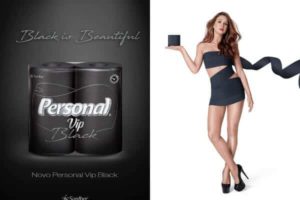
A Brazilian toilet paper company has issued a statement about their controversial ad. (Santher)
A Brazilian toilet paper advertisement has been amended because of a controversy. Santher, a paper distributor in São Paulo, launched the Personal VIP Black brand of tissue Monday, Oct. 23, according to The Guardian. Backlash swiftly followed the ad, which included a Brazilian actress Marina Ruy Barbosa — wrapped in black colored toilet paper.
“Black Is Beautiful,” the ad said.
In a statement issued Tuesday on its website, Santher said it sought the black color of the paper because the hue was “considered [an] icon of style, luxury and refinement.”
“In this way, the company announces that the slogan has already been withdrawn from the campaign, in addition to apologizing for the mistaken assumption of the phrase adopted [by] the Black movement, which we both respect and love.”
Other Companies Caught In Advertisement Controversies
Gap Apologizes for Arguably Racist Ad Where Black Girl Is Used as Armrest
Nivea Faces Harsh Backlash Over Ad Claiming Skin-Lightening Lotion Makes You Look Younger
Dove Apologizes for Facebook Soap Ad That Many Call Racist
Many accused the campaign of taking over the #BlackIsBeautiful campaign, which is a movement that begun in the 1960s to praise Blackness.
In Brazil #Blackisbeautiful is not a cause,now is toilet paper.Where do black lives matter? @blackpanterapro #brazilianracism #santher pic.twitter.com/rhdt0rGXmO
— Flávia Soares (@_fsvSoares) October 24, 2017
“The color of the paper is not the problem,” one user said. “The advertising used ‘Black is beautiful’ slogan, which was a ‘S—‘ and Santher can f— themselves.”
A cor do papel ñ é o problema.
A publicidade usou “black is beautiful” de slogan, que foi uma CAGADA e a Santher tem mais que se foder mesmo— Letícia Fonte Boa (@LeticiaFonteBoa) October 24, 2017
“It’s not the color of the paper, my dear,” someone else said. “It is the expression of a 1960s movement to fight racism in an ass paper propaganda.”
Não é a cor do papel, meu caro. É a expressão de um movimento de 1960 de luta contra o racismo em uma propaganda de papel de bunda.
— Hitchens ONE (@HitchensONE) October 25, 2017
“Do you have any idea what the phrase ‘Black is Beautiful’ meant in the ’60s?” another asked. “I don’t blame you. The issue is not black colored paper. Research.”
Você tem ideia do que foi a frase Black is Beatiful na década de 60? não a culpo. A questão não é cor do papel preto. Pesquise
— ARainha (@CelitaCouto) October 25, 2017