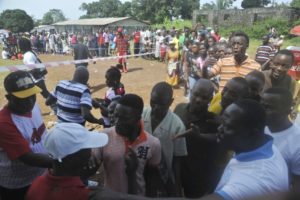
People wait to cast their votes during a presidential election in Monrovia, Liberia. (AP Photo/Abbas Dulleh)
MONROVIA, Liberia (AP) — Liberians chose between 20 candidates vying to succeed Africa’s first female president Tuesday, as voters picked the person they believe will best help the West African country move past the Ebola crisis that killed nearly 5,000 people.
The election is already expected to go to a runoff vote because of the crowded field. When the transfer of power takes place, it will be the first of its kind in the nation in more than 70 years.
As Nobel Peace Prize winner Ellen Johnson Sirleaf prepares to step aside, there are fears that if election results aren’t accepted the violence of Liberia’s past could rise again. Sirleaf led the country’s recovery from a 14-year civil war.
“This election now is crucial and important because as you can see the peace is very fragile right now, and we need a smooth transition from one government to another,” said Stevera Toh, a 32-year-old accountant. “So we have to vote wisely and make the right decision for our country, our kids and generations.”
Long queues remained at many polling stations at closing time, with those in line still able to vote.
Andrea Kamara, a 27-year-old marketing consultant, said impoverished Liberia needs development. “Whoever gets into office needs to focus on infrastructure, education and sustaining the peace,” she said.
Liberia’s health system was decimated by the Ebola outbreak in 2014-2015 that posed Sirleaf’s biggest challenge.
More than 2.1 million voters registered to vote at nearly 5,400 polling stations throughout the country that was established by the United States in the 19th century for freed black slaves.
Given the high number of presidential candidates, it is unlikely anyone will win more than 50 percent of the vote, taking the elections to a second round, likely in November.
Vice President Joseph Boakai, one of the front-runners, told reporters that if he wins, “we are not going to be a donor-driven country. Liberians are going to build their economy.”
His main contender is 51-year-old former international soccer star George Weah. Weah’s running mate is Jewel Howard-Taylor, the ex-wife of former President Charles Taylor, who is jailed for war crimes.
Weah ran against Sirleaf in 2005, winning in the first round but losing to her in the second.
Another top candidate is former warlord Prince Johnson, who videotaped himself as his fighters tortured and killed President Samuel Doe in 1990.
The only female vying for the presidency is international model MacDella Cooper, 41, who has promised she would take only $1 a year as salary if elected.
Taking the reins from Sirleaf, who has brought Liberia international attention and aid, will not be easy. But the transfer of power stands as an example in Africa where many leaders refuse to step aside.
“Let us take a moment to reflect on how far we have come as a nation, and as a people, from a society destroyed by conflict and war to one of the most vibrant democracies in the West Africa region,” Sirleaf said Monday.
International observer missions were watching the polls. Final results for the first round are expected to be announced by Oct. 25.
Liberian security forces are in charge of the polls for the first time since 2003. The United Nations peacekeeping mission handed over security responsibilities two years ago. The 5,000-strong police force is supported by a new army of about 2,000 troops who are on standby.
Police have worked at “building trust and confidence” ahead of the election, police chief Gregory Coleman told The Associated Press.
___