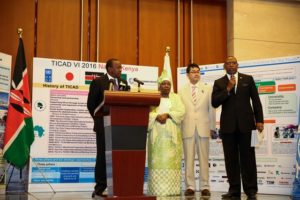
Kenyan President Uhuru Kenyatta (1st L), Nkosazana Dlamini-Zuma (2nd L), Chairperson of the AU Commission, and Katsuyuki Kawai (2nd R), the Special Representative of the Prime Minister of Japan to the AU Summit, attend a press conference in Addis Ababa, capital of Ethiopia, on Jan. 31, 2016. The sixth Tokyo International Conference on African Development (TICAD) will be held in Kenya from Aug. 27 to 28, President Uhuru Kenyatta announced Sunday on the sidelines of the AU heads of State Summit in Addis Ababa. (Xinhua/Pan Siwei)
TOKYO — Japan takes its aid show to Africa this weekend, with a huge development conference in Kenya, hoping quality will trump quantity in the battle for influence against cash-rich China.
Prime Minister Shinzo Abe — fresh from an appearance as Super Mario at the Olympic Games in Rio — will meet with dozens of leaders from across Africa in Nairobi.
Officials say the Japanese prime minister will use the two-day gathering to unveil aid and investment projects, including those related to healthcare.
Tokyo has a well-established presence in Africa, but its financial importance to the continent has long-since been eclipsed by regional rival China.
The world’s second-largest economy — a resource-hungry giant — recorded total trade with Africa of about $179 billion in 2015, dwarfing Japan’s approximately $24 billion.
“Japan has a sense of rivalry with China, which has provided large-sized assistance,” said Koichi Sakamoto, professor of regional development studies at Toyo University.
“Since Japan can’t fight China in terms of amounts of cash, it needs to stress quality,” Sakamoto added.
This weekend’s meeting, which will be attended by Kenyan President Uhuru Kenyatta and South Africa’s Jacob Zuma, amongst others, is the sixth edition of the Tokyo International Conference on African Development, or TICAD.
The forum was first convened in 1993 and, until now, has always been held in Japan.
The move to Africa this year came at the behest of the host continent, but reflects a drive to bolster Japanese clout as the modern-day Scramble for Africa gathers momentum.
The European Union, China, India, South Korea and Turkey have similar aid ventures to court African leaders as they look for a slice of the continent’s resources and its burgeoning markets.
But as a relatively early entrant, Tokyo’s role has proved invaluable to Africa.
TICAD — co-organized by Japan, the United Nations, the World Bank and the African Union — “paved the way” among aid programs because it was among the first of such efforts, a senior Kenyan government official, who declined to be named, told AFP.
Aid and infrastructure projects offered by Tokyo and its rivals, are not, of course, a one-way street; Japanese firms often stand to benefit from the vast sums of cash consumed in the construction of roads, ports and railways half a world away.
Projects under tender at the moment include the $250 million first phase of expansion at the congested Kenyan port of Mombasa, as well as the resurfacing, widening and construction of roads in cities and on rural highways.
As well as diplomats and politicians, TICAD will also gather business executives and other participants from Japan and Africa in what Abe hopes will be a boost to two-way trade.
But enthusiasm may be dampened by the security concerns over some of Africa’s more lawless areas.
Such danger was driven home in 2013 when a gas plant in Algeria built by a Japanese company was overrun by Islamist gunmen, who killed 40 people, including 10 Japanese.
Shu Nakagawa, a foreign ministry official in charge of the forum, said Japanese companies are “rather cautious” over mounting challenges on the continent.
That includes the growing threat from radical Islamist groupings, such as Boko Haram and the Shabaab group — which is active in Kenya.
Read more here.