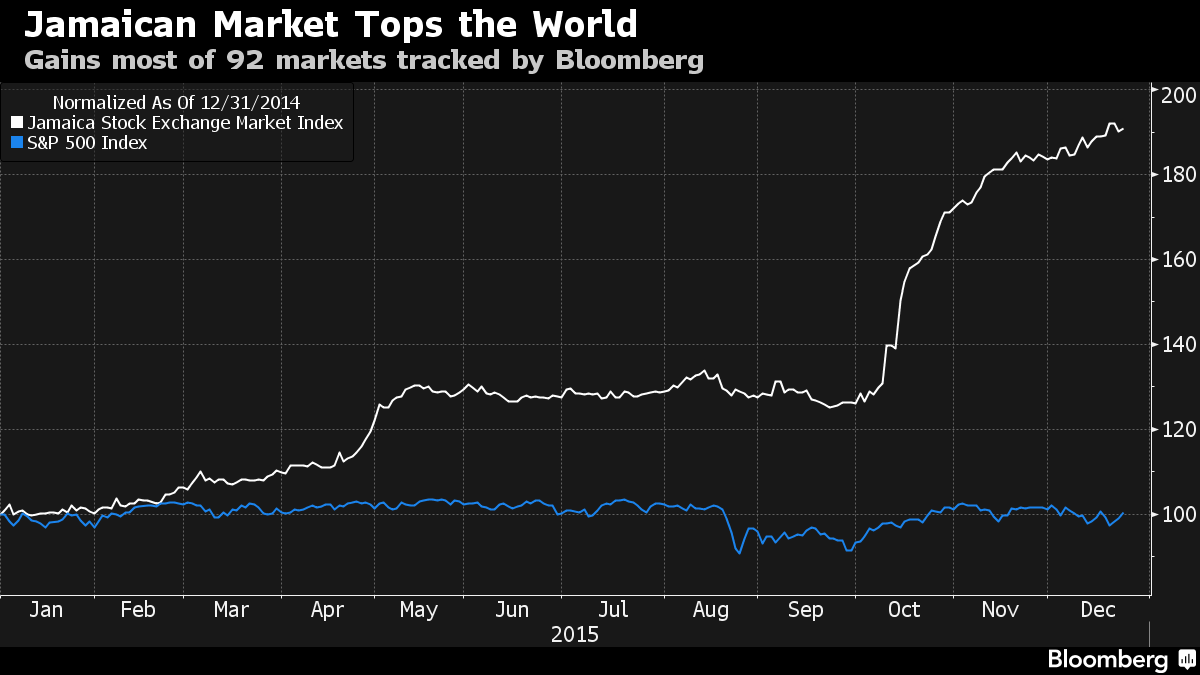
 Jamaica may bring to mind rum daiquiris and Bob Marley but its stock market had a better year than any other across the globe.
Amid the middling returns of the world’s best known indexes — the Dow Jones Industrial Average dipped about 1 percent, the Euro Stoxx 50 lost 6 percent in dollar terms– foreign acquisitions, stronger investor safeguards and a rebounding economy helped the Jamaica Stock Exchange surge more than 80 percent in 2015.
With a market capitalization of about $5.3 billion (the Dow has $5.23 trillion), Jamaica lives on the fringe of frontier status. And although the exchange’s benchmark index lost 5 percent last year and 13 percent in 2013, investors should pay attention, according to Carl Bennett, a vice president of investor relations at Bank of New York Mellon.
“I’m really impressed with what they’ve done to attract capital to the market,” he said, pointing to new measures to combat insider trading and market manipulation.
With economic growth forecast to accelerate for a third straight year, reaching 1.4 percent in 2015 according to estimates compiled by Bloomberg, the Caribbean island of 2.8 million people is slowly emerging from recession while struggling with one of the world’s highest debt burdens. The government has restructured local bonds twice since 2010, accepting an International Monetary Fund-led financing package in 2013. That didn’t deter individual Jamaicans and institutional investors from pouring money into local stocks this year, said Jovano Johnson, an equity trader at Kingston-based Mayberry Investments Ltd.
Twenty-nine of the 57 stocks traded on the main and junior markets in Jamaica saw year-over-year post-tax profits rise 10 percent or more. Eight of those saw profits spike more than 100 percent, led by the Jamaica Stock Exchange Group’s 1,658 percent growth for a $1.2 million profit for the 12 months that ended in September.
Read the full story at bloomberg.com