Jeff Roberson/Associated Press
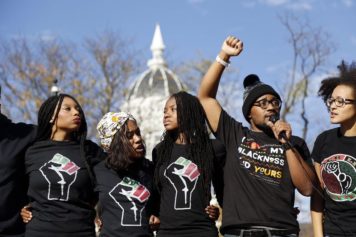
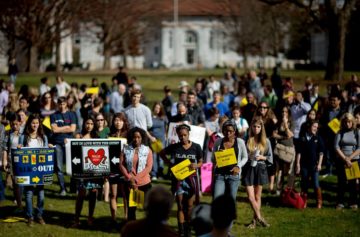
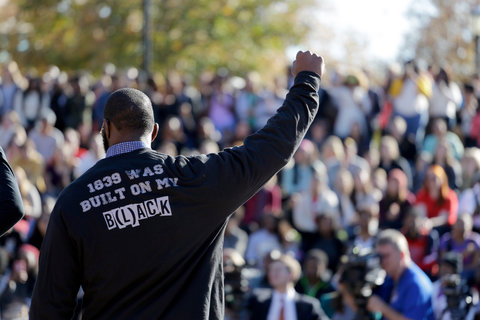
Today, students across the country gear up to protest on their respective college campuses for the national day of action, #StudentBlackOut.
The coordinated action was organized by The Black Liberation Collective (BLC), a newly formed coalition of student groups from across the nation. The group encouraged students to organize events on their campus in order to further the movement of addressing racial inequality in higher education.
#studentblackout do something at your own institution … Hold them accountable! pic.twitter.com/X3YQ2HAAtX
— Tatyana (@BeamMeUpTaty) November 17, 2015
“We are protesting because we are angry and tired. We are tired of attending institutions that don’t prioritize creating environments in which we can thrive”, says Camille Borders of Washington University in St. Louis. “We are tired of being asked to be patient to wait our turn. Now is the time for transformation and change. Through disrupting the norm we hope to create institutions of higher education in which we can thrive not just survive.”
Over 300 people joined BLC’s conference call, with over 100 students expressing interest in organizing on their campus. Organizers on the call directed students to their website for resources to aid in developing a protest and informed them of the national demands, which include divestment from prisons, investment in communities and free tuition for Black and indigenous students.
https://t.co/STnJCrnVDj #studentblackout pic.twitter.com/bqwZOTvaMr
— BLC (@blacklibco2015) November 16, 2015
Using the hashtag #StudentBlackOut, students expressed grievances, issued demands, and promoted protests. Students at Yale, Princeton, Morehouse and Mizzou are expected to hold mass demonstrations.
And thankful to @Lavernecox for helping us amplify. Walk out and sit in. Princeton University. 11/18. pic.twitter.com/pmXqC9Drao
— Ida Bae Wells (@DestinyAriel) November 18, 2015
be there #studentblackout #ATLBSU pic.twitter.com/ltPL9WsLNz
— habitual linestepper (@lambarghini_) November 18, 2015
BLC began organizing in early September and officially launched after students at the University of Missouri were able to successfully force their president to step down for failing to address a number of racist incidents on campus. BLC is “dedicated to building infrastructure for Black students around the globe to build power, using an intersectional lens, in order to make our campuses safe for all Black students.”
“Students are protesting because we’re tired of the conditions that surround us”, said Muenfua Lewis of Kansas State University. “We’re fighting for each other, and we’re fighting for the black students of the future. The uplift and liberation of our people is on our agenda, starting through the work on our campus.”
The movement has, however, sparked backlash. Individuals have been arrested for posting anonymous threats on the application Yik Yak. On Tuesday night, students at Kean University received death threats as they camped out to protest racism on campus.
I go to this school and this should not be taken lightly. Black #keanuniversity students are receiving death threats pic.twitter.com/apaFdQ7wDf
— Savon Bartley (@SavonBartley) November 18, 2015
“For far too long black students have been treated unfairly and unequal to their white counterparts. It’s time we put an end to this mistreatment,” said Niani Byrd of Christopher Newport University. “I refuse to be silent any longer.”