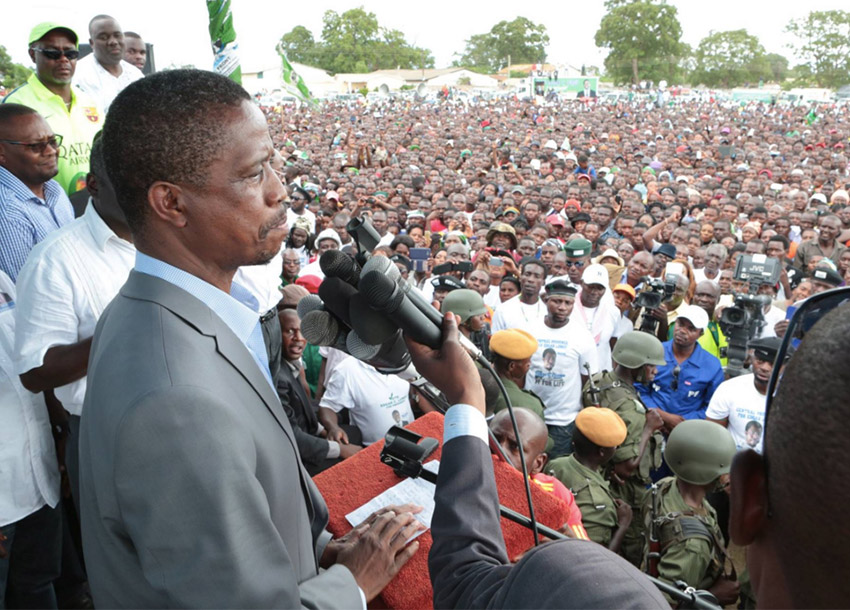
Zambian President Edgar Lungu
Zambian President Edgar Lungu called off soccer games and closed bars and restaurants for a day of national prayer. “I personally believe that since we humbled ourselves and cried out to God, the Lord has heard our cry,” Lungu told the 15 million people of the landlocked African nation. Sadly for Zambians, God heard things differently.
Lungu implored his people to pray for the national currency, the kwacha. Having dropped by nearly half since he took over in January – almost perfectly tracking the sliding price of his country’s chief export, copper – Zambia needed some divine intervention. Since imploring his people to genuflect, the kwacha has fallen another 14 percent.
Zambia is a cautionary reminder of how quickly the prospects for growth and prosperity can shift, especially in sub-Saharan Africa. A year ago, Zambia was expected to lead its neighbors in boosting economic output. In June of last year, the World Bank forecast Zambia’s gross domestic product would be nearly 7 percent greater by the end of 2015. The country even warranted a shout-out in our Breakingviews Predictions book.
As it stands, the country will be lucky to expand by more than 5 percent by the end of the year. While that’s certainly better than, say, Italy, it needs to grow far faster to pull Zambians out of poverty. Gross domestic product per capita in Zambia is below $2,000, or just an eighteenth of Italy’s. It’s a similar story from Accra to Zululand.
While the World Bank calculates that sub-Saharan Africa’s GDP growth has been faster than the developing world’s average, excluding China, since the 2008 financial crisis, progress is threatened on too many fronts. Just a few of them are of domestic manufacture. While bad economic thinking and corruption are still rampant in much of Africa, Mother Nature, alongside myriad problems in the rest of the world, are set to take an unusually high toll.
Zambia and its neighbors Botswana and South Africa account for about a quarter of sub-Saharan Africa’s GDP. The oil spigot that is Nigeria comes in for about a third. The nations on the southern tip carry considerable weight in determining the region’s growth picture. So a potentially devastating water shortage there comes at a terrible moment.
Water is needed to grow food for people and animals. It’s also critical to the mining industry – not simply as a raw material used in the process of extraction, but to generate energy. Zambia gets nearly all of its electricity from three major dams, including one at the usually glorious, now dry, Victoria Falls. As a result, copper production has slowed just as the metal’s price has dropped. Many mining operations are only managing to stay open by using generators powered by expensive, imported diesel fuel.
Read the full story at mobile.brakingnews.com