10 Examples That Highlight The School to Prison Pipeline is Disastrous for Black Girls Too

black girls coloring in uniform

Black Girls Are Penalized for Protecting Themselves

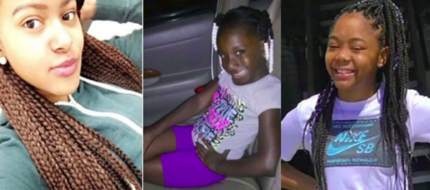
Black girls often feel unprotected in school settings because they are often punished for defending themselves. Zero-tolerance policies exacerbate their vulnerabilities rather than make them safer because they receive the same punishment as the person bullying them. A report by the National Women’s Law Center and the NAACP Legal Defense and Educational Fund found that Black girls report widespread sexual harassment in school. According to one survey, 56 percent of school-age girls report experiencing sexual harassment. The same study found that Black students were more likely than white students to “change the way they go to or from schools,” or even change to a new school, in response to sexual harassment. Black girls experience more aggressive forms of harassment than white girls. A 2001 national survey of eighth- through 11th-graders found that 67 percent of Black girls reported being “touched, grabbed, or pinched in a sexual way,” compared to 56 percent of white girls. And 28 percent of Black girls reported being “forced to kiss someone,” compared to 15 percent of white girls. A study of Black female students in St. Louis found that experiencing sexual harassment at school had “tangible negative outcomes … including harmful effects on school performance, the curtailment of social networks, peer rejection, and negative emotional outcomes.”

black girl shooting

Teachers Influenced by Negative Stereotypes

Negative perceptions of Black female behavior, informed by stereotypes, lead teachers to assume Black girls require greater social correction and thus lead to increased disciplinary referrals, according to the report by the National Women’s Law Center and the NAACP Legal Defense and Educational Fund. For example, Black girls who are outspoken in class, who use profanity or who confront people in positions of authority — as well as Black girls who are perceived as dressing provocatively — are disproportionately disciplined. Indeed, Black girls are at greater risk than other girls of receiving citations for dress code violations and for talking back to teachers, as well as for much less severe behaviors such as gum chewing, defiance and failure to comply with prior discipline. This forces them into a no-win situation: they either conform to white, middle-class notions of how girls should act and be quiet and passive, which ultimately does not serve girls well in their pursuit of an education; or they speak up and get disciplined for defying those expectations and conforming to educators’ stereotyped expectations for Black girls.

Still independent.

We hope this story was worth your time. For over 14 years, Atlanta Black Star has stayed Black-owned and independently run. We didn't get here by waiting on ad budgets that were never built to prioritize us. Our readers did that.

Corporate support for Black media has always been thin. Outlets like ours get roughly 1% of the $170 billion spent on U.S. advertising each year, and that margin is shrinking further as advertisers walk back the DEI-linked commitments they made in 2020. That's the backdrop. It's not why we're asking.

The wider picture isn't any steadier. Newspaper ad revenue has fallen more than 80% since 2005, and local newsrooms are closing at a rate of roughly two a week nationwide. When outlets go under, it's rarely the ones built to center a Black perspective from the ground up that get to stick around.

We know a request for support isn't why you came here. But without readers choosing to fund this work directly, the depth of reporting we can do at home and abroad shrinks along with everyone else's. If you're not in a position to give, that doesn't change how much we value you as a reader.

If you are able to, a recurring contribution does more for us than a single one-time gift, because it lets us plan the next investigation instead of just the next invoice. It takes about 30 seconds, no long form, no account. Thank you for continuing to support independent journalism and freedom of the press.

Back to top