Credit: Scott Olson/Getty Images
A series of audio recordings have managed to confirm that the no fly zones that were put into effect over Ferguson, Missouri, for nearly two weeks were really intended to prevent media from capturing the chaos that unfolded following the death of 18-year-old Michael Brown.
It was nearly three months ago that Michael Brown was shot and killed by Ferguson police officer Darren Wilson.
The death of the unarmed Black teen sparked what became an international movement for justice as communities across the globe spoke out against the police brutality that has plagued Black communities for ages.
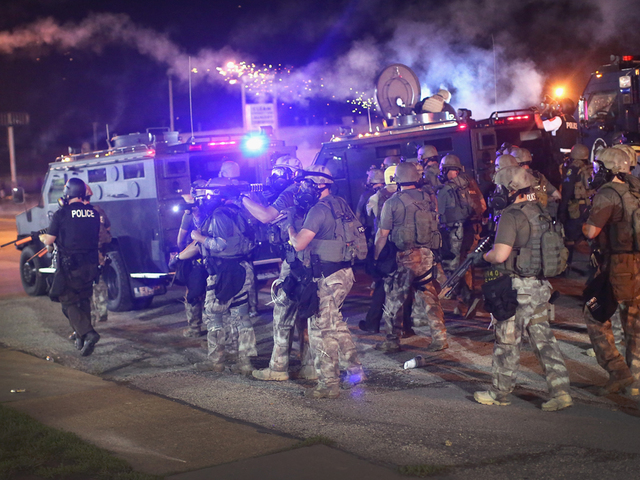
Protestors filled the streets of Ferguson and police fired back with tear gas and rubber bullets – and authorities wanted none of it to be caught on tape.
According to the audio recordings obtained by The Associated Press, officials were more concerned about keeping the media out of Ferguson than they were about keeping citizens out of harm’s way, as the St. Louis County Police Department initially claimed.
“They finally admitted it really was to keep the media out,” one Federal Aviation Administration (FAA) manager said on the recordings. “But they were a little concerned of, obviously, anything else that could be going on.”
Later in the recording, a manager at the FAA’s Kansas City center said that the police blatantly stated that they did not care if commercial traffic went through the area but the media couldn’t be there.
“There is really… no option for a TFR (temporary flight restriction) that says, you know, ‘OK, everybody but the media is OK,’ “ the manager added on the recordings.
Such focus on keeping the media out were direct contradictions to the claim that the no-fly zones were about keeping the passengers on airplanes safe due to shots being fired in the air.
At the time, police claimed that shots managed to hit a police helicopter.
No police officials were able to confirm damage to any of their helicopters and authorities still have not provided an incident report on the matter.
According to the FAA managers on the tape, the helicopter shooting was nothing more than an unconfirmed “rumor.”
With no aerial coverage of the chaos that swept Ferguson, the entire world was cheated out of seeing an unvarnished view of what has been described as one of the most serious episodes of civil violence in recent memory.
According to American Civil Liberties Union staff attorney Lee Rowland, that’s the most concerning fact of them all.
“Any evidence that a no-fly zone was put in place as a pretext to exclude the media from covering events in Ferguson is extraordinarily troubling and a blatant violation of the press’ First Amendment rights,” Rowland told Mashable.com.
This isn’t the first time authorities have been accused of trying to silence the media and control major coverage of Ferguson.
Officers arrested two journalists after they refused to put their cameras up as police evacuated the McDonald’s they were working in.
They were soon released after it was revealed they were journalists for The Huffington Post and The Washington Post.
According to CNN, at least six more journalists were arrested during the protests.